Star, brown dwarf or planet
- If the mass of the central core is small, $M < 3\times10^{28}\text{kg}$ which corresponding to $13M_J$ masses of Jupiter), it becomes a gas ball and forms a giant free floating planet (see what is an exoplanet?).
- If $13M_J < M < 60M_J$, it forms a brown dwarf ? , an object that remained a mystery for a long time and where nuclear combustion concerns only the fusion of D (deuterium) into He (helium).
- If $M \gtrsim 60M_J$, the central temperature exceeds $5 \times 10^6\text{K}$ and the fusion of H (hydrogen) into He (helium) begins, igniting a star.
The minimum mass required to ignite a star is the subject of much discussion. The most recent theoretical models (2023) give a minimum mass of 78.5 masses of Jupiter for a chemical composition similar to that of the Sun.
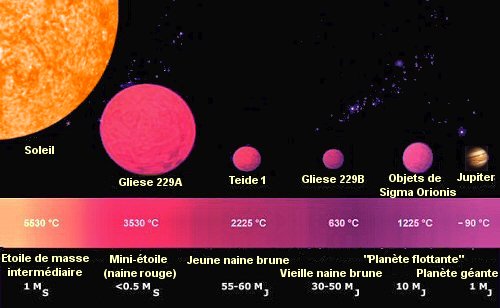
These three scenarios can take place in the vicinity of a star in the process of forming. This leads to a system of double or multiple stars (of which there are many in the Universe) or a system associating a star and a planet or a star and a brown dwarf ? .
If the above scenario concerns an isolated condensation of gas, it will, depending on the mass of gas, lead to an isolated star, an isolated brown dwarf ? or quite possibly a free floating planet! In all these cases, the composition of the brown dwarfs ? and the planets is the same as that of the stars, that of the Interstellar Medium ? .
Isolated brown dwarfs ? and free floating planets have been detected in the infrared. We do not know if they formed alone, like stars, or if they were formed in the environment of a star and then ejected.
When the object formed is a star, we will look at what is happening in its environment as it is there, in the circumstellar disc, that “real” planets are formed.