Do exoplanets look like Earth?
YES, exoplanets look like Earth:
- Like Earth, exoplanets are spherical
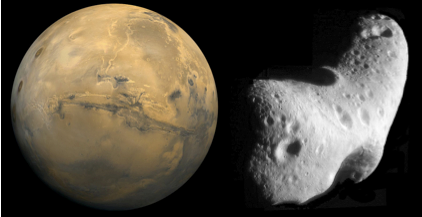
It is not possible to see the shape of the exoplanets, but, because of the force of gravitation, a planet has to be round. If a planet had a “corner”, that is a very high mountain, it would be heavier and collapse under its own weight like a wet sandcastle. The planet’s gravity is greater than the rock’s cohesive force. This is why, on Earth, there can be no mountain higher than Everest (8 km). Mars is 10 times less massive than Earth. The weight of the Martian mountains is therefore relatively lower. The highest mountain on Mars, Olympus Mons, is three times higher than Everest, with a summit altitude of 25 km. On Venus, the highest point (Mount Maxwell) is 12 km. The mass of Venus is 80% that of Earth.
Small planets, satellites ? and asteroids ? are spherical if larger than about 100 km. Some, such as Haumea, can be elongated owing to centrifugal force. When they are small, they retain the shape they had when they were formed.
- Like Earth, exoplanets do not emit visible light.
The planets in the Solar System are visible in the sky because they are illuminated by the Sun. From Earth, we only see their illuminated part as crescents of various sizes (the phases). Similarly, exoplanets are only visible if they reflect the light from their star. In addition to the reflected visible light, exoplanets – especially when young – emit infrared light that is invisible to the human eye, but can be detected with the right cameras, such as those of the James Webb Space Telescope (JWST).

NO, exoplanets do not look like Earth
- Small, solid, Earth-like exoplanets are more numerous than massive, gaseous Jupiter-like exoplanets. However, it appears that the most numerous exoplanets are medium-sized, icy planets like Neptune, but this has yet to be confirmed because the smaller planets are hard to detect.
- Many are very close to their star, even closer than Mercury is to the Sun, and their surface temperature is several hundred degrees.
- Many exoplanets are detected around stars very different from our Sun. On Earth, solar radiation completely governs the physical and chemical exchanges, and therefore life itself. A planet orbiting a far hotter, far colder, or even a variable or binary star, will probably be very different from Earth.
- Many exoplanets have eccentric orbits which take them away from and bring them back close to their star during the course of the year, whereas Earth remains at an almost constant distance from the Sun. A planet with an eccentric orbit has a varying distance from the star and spends more time far away from it because of Kepler’s 2nd law.

Most exoplanets are detected around stars in the neighbourhood of our Sun, as the rest of the Galaxy ? is inaccessible.
As shown by the table of exoplanets,
- there are planets with the mass of the Earth
- there are planets around stars similar to our Sun
- there are planets at the same distance from their star as the Earth from the Sun
- there are planets with density close to that of Earth
- there are planets with an atmosphere
- there are planets in the habitable zone around their star
But so far (12/10/2026), none has been found with all these properties.